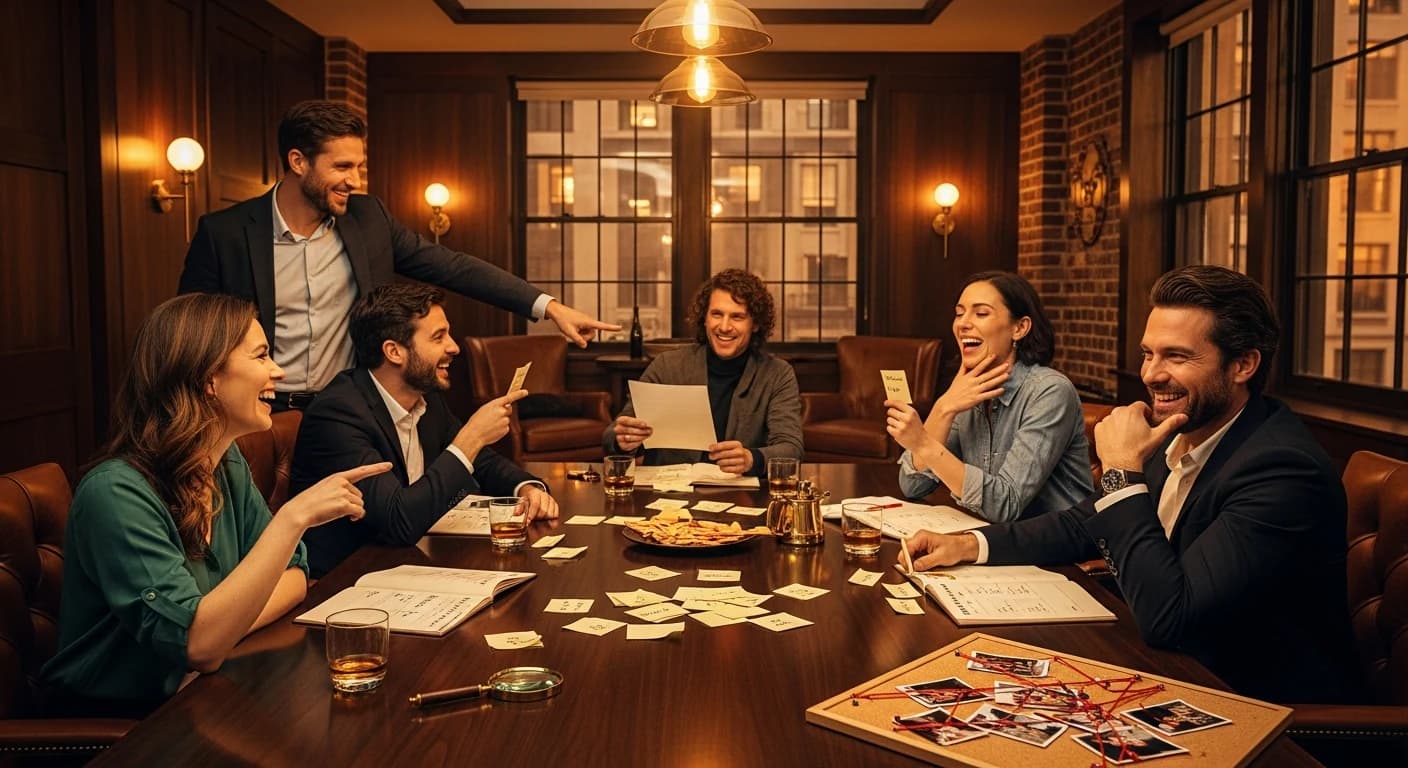
Every team day starts with the same shortlist. Someone suggests an escape room, someone suggests a trivia night, and someone quietly hopes it will just be dinner. All three work — this isn't a takedown of any of them. The real question is what you want the evening to optimise for: a task your team completes together, answers your team recalls together, or a story your team creates together.
That distinction sounds abstract. It isn't — it decides who talks to whom during the event, and what's left of it on Monday.
The three formats at a glance
| Escape room | Trivia night | Murder mystery | |
|---|---|---|---|
| What it is, structurally | A task completed against the clock | A knowledge contest in rounds | A story played out between people |
| Where it happens | At the escape room's venue | Anywhere | Your venue — office, restaurant, holiday rental |
| Group handling | Rooms built for small groups; bigger teams split up | Any headcount, split into tables | One game for 4–20 players, everyone in the same story |
| How people interact | Around the puzzles — object-mediated | Within each table, about the answers | Person to person — conversation is the game |
| Who runs it | The venue's staff | A quizmaster | One of you, with a host guide and audio narration |
| What's left afterwards | A solved room and a finish time | A scoreboard | A story with characters — who lied, who accused, who got away with it |
Escape rooms: a task your team completes together
Let's be fair first, because escape rooms deserve it: they genuinely work. Peer-reviewed research on escape rooms as team activities reports positive effects on group cohesion, communication, and how well people understand each other's roles in a team. The countdown is real adrenaline, the win is cleanly shared, and — a genuinely underrated feature — nobody has to perform. If your goal is a fast, shared win with zero social exposure, book the room. That's not a consolation prize; it's the right tool for that goal.
The structural trade-off is how the team interacts while it's happening. An escape room is convergent and object-mediated: everyone works on the same puzzles, attention flows toward the locks and props, and the conversation is about the task — "try this key", "what's the pattern". In most groups, the most assertive problem-solvers naturally end up driving, and a bigger team doesn't share one experience at all: it splits across different rooms or staggered time slots, and half the stories from the day start with "well, in our room…"
None of that makes it a bad event. It makes it a task — and a task is what it optimises for.
Trivia: answers your team recalls together
Trivia is the low-risk option, and there's real value in that. It needs almost no organisation, works at any headcount, and everyone understands the rules in one sentence.
The trade-off, again, is the interaction it produces. A quiz rewards what people already know, so within two rounds the room has sorted itself into the people who answer and the people who watch them answer. The conversation stays inside "are you sure it's B?" — and nothing in the format needs the quiet colleague to say a word all evening. You leave having confirmed who knows their 80s music, and knowing your colleagues exactly as well as before.
If you need something tomorrow for a big, casual crowd, trivia is the honest answer. Just don't expect it to change who talks to whom.
A murder mystery: a story your team creates together
A murder mystery is built on a different mechanic: the conversation is the game. Each player gets a character with a backstory, a motive, a secret, and information somebody else at the table needs. The case literally cannot advance unless specific people seek each other out, trade what they know, hold something back, accuse, and defend. The quiet colleague isn't encouraged to participate — the game doesn't work without them, because they're the only one holding their piece of the story.
There's a known reason this kind of structure does something ambient mingling doesn't. Psychologists studying how strangers become close — Arthur Aron's classic closeness experiments in the 1990s, and later work on turn-taking in conversation — found that structured, reciprocal back-and-forth, where two people take turns actually disclosing things to each other, produces markedly more closeness and liking than the same time spent on small talk. Those studies were about pairs of people getting acquainted, not about party games — but the structure they describe is exactly what a mystery enforces all evening: walk up to a specific colleague, reveal something, get something back.
The practical shape of the evening, briefly:
- It happens at your venue, around your dinner. The game is built in rounds that fold around a meal — the dinner isn't the break from the activity, it's the stage for it.
- One of you hosts it, and that genuinely works. The kit includes a host guide with round-by-round instructions and AI audio narration that opens the night and each round. Nobody has to perform, and there's no external facilitator at your table.
- It's written for your team. Setting, era, and occasion are free text, and character names, traits, and quirks are editable — the case can play out at a fictional company suspiciously like yours. For the full playbook, see our guide to murder mystery team building.
- A distributed team can actually play. An escape room needs everyone in the same building — someone has to fly. The mystery kit is PDFs and audio narration, so a remote or hybrid team can run the whole evening over a video call. It's better in person, but it works.
- Nobody has to die. If a murder feels wrong for a work event, the Intrigue mode swaps the body for a theft, a blackmail note, or a scandal — the same investigation with party-proof stakes.
One honest limit on our side too: a single game supports 4 to 20 players, each with their own character. Twenty is a hard cap, not a suggestion.
What's still being talked about on Monday
Here's the part that separates the formats most, and it comes down to what each one leaves behind.
There's solid evidence that narrative sticks in memory in a way plain information doesn't: a meta-analysis of more than 75 studies with over 33,000 participants found that people recall and understand stories consistently better than expository material. That research is about reading texts, not team events — but it points at something you can check against your own experience: what survives from an event is its story.
A solved escape room leaves a result — "we got out with four minutes left." Satisfying, tellable once. A murder mystery leaves a plot with your colleagues as the characters: the accusation that landed, the alibi that collapsed over dessert, the quiet analyst who turned out to be running the whole conspiracy. That's a story with heroes and villains from your own team, and it gets retold — in the kitchen, in stand-ups, in the "remember when Janet cracked in round three" months later. The retelling is the team building.
An honest decision guide
- Choose the escape room if you want a fast, shared win under time pressure and a format where nobody has to act, speak up, or leave their comfort zone.
- Choose trivia if you need minimal organisation for a large, casual crowd and the evening is more social gathering than structured event.
- Choose a murder mystery if your team is 4–20 people, dinner is the centrepiece, and the goal is the human one: people who don't usually talk to each other, talking — and a story they'll still be retelling weeks later.
Frequently asked questions
Isn't hosting a murder mystery a lot of work for the organiser? Less than it sounds. You describe the event in the wizard, the game generates in about 15 minutes, and you print the kit — character dossiers, host guide, clue cards. The audio narration carries the storytelling. For the full run-through, read our hosting guide.
What if colleagues hate role-playing? They don't have to act — they have to chat, ask questions, and protect a secret. In practice, the loudest "I don't do role-play" colleague is usually leading an interrogation by round two.
Does it work with the boss in the room? Yes — often best when the boss is a suspect. Choose a serious or comedic tone to match your culture, and the Intrigue mode if a death doesn't fit the occasion.
What does the team actually receive? Printable character dossiers for each player, a host guide with round instructions, clue cards, and AI audio narration — generated in about 15 minutes as a digital download. Print and play.
Pick the format, then make it yours
If the comparison points you toward the mystery, the murder mystery team event page shows the full picture — sample roles, what's in the kit, and answers to the questions organisers ask. From there, build your team's mystery: describe the setting, pick murder or intrigue, set the tone and length, and the game is generated for exactly your headcount.
You might also enjoy
- Murder Mystery for Team Building — Why the format works as a team event, and how to customize it until it's unmistakably yours.
- Boxed Murder Mystery Kits vs AI-Generated Games — If you've settled on a mystery, here's how the product options compare.
- How to Host a Murder Mystery Dinner Party — The complete hosting guide, from setup to the final reveal.