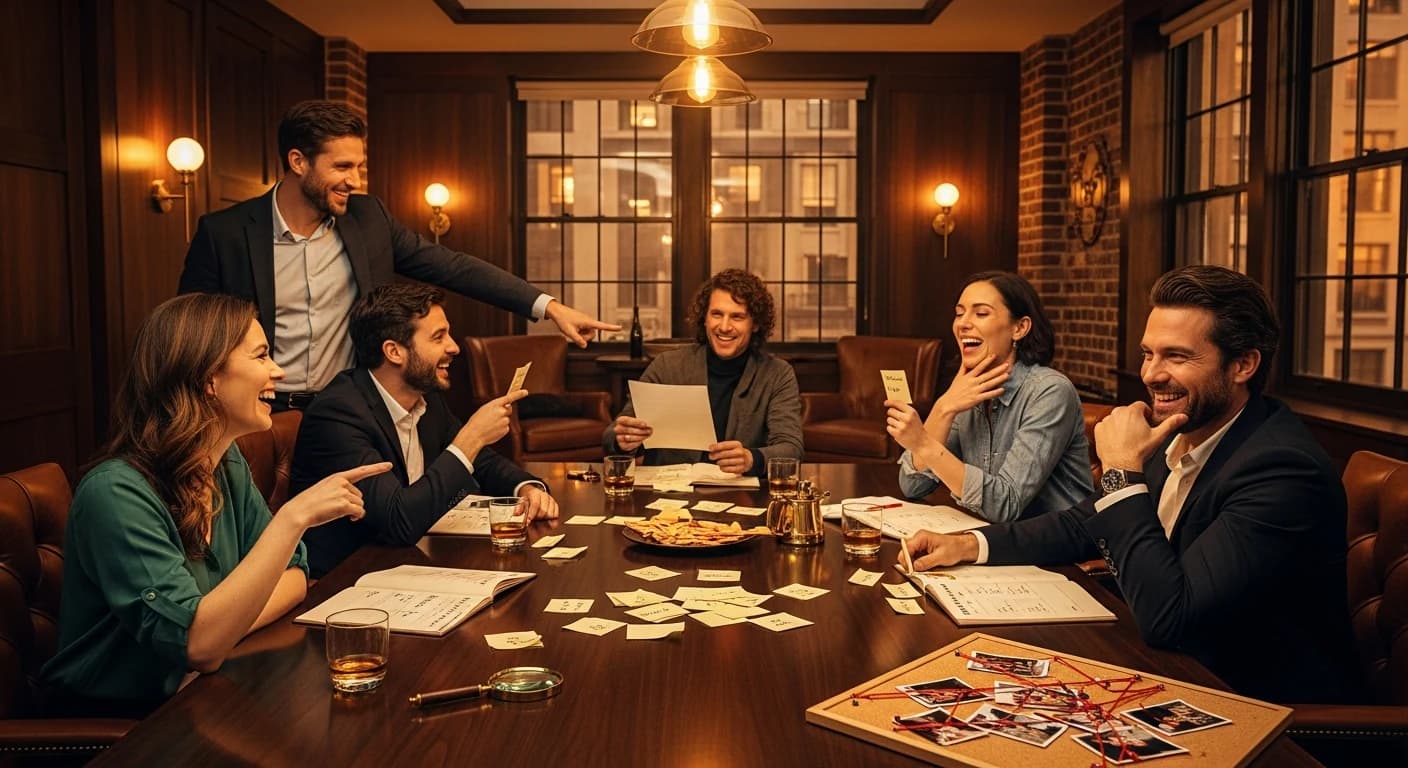
Most team-building activities have a problem. The trust falls feel forced. The escape rooms reward the same three problem-solvers every time. The "fun" offsite dinners turn into the regular Tuesday meeting with worse posture.
A murder mystery solves the underlying issue: it's structurally inclusive. Every player has a role, unique information, and a real reason to talk to everyone in the room. There's no skill gap to penalise quieter team members. And the reveal at the end becomes a shared reference point your team talks about for months.
This article covers why it works for teams, what to customize to make it feel like your team's event, and how to keep the corporate-parody angle tasteful enough that everyone laughs with each other, not at each other.
Why it works for teams
| Activity | Skill required | Engagement | Memorability |
|---|---|---|---|
| Trust falls | None (but the vibes are off) | Low | Awkward |
| Escape room | Logic puzzles | High for solvers, low for the rest | Medium |
| Karaoke night | Brave personality | Polarising | Mixed |
| Corporate dinner | None | Conversational | Low |
| Murder mystery | None — entirely social | High for everyone | High |
Murder mystery games are structured for the dynamics that make a team-building event actually work:
- Everyone has a role. Each player gets a character with their own backstory, motive, secrets, and round-by-round information. No bystanders. No one gets sidelined for not being great at puzzles.
- No skill gap. Unlike escape rooms or trivia, success doesn't depend on logic puzzles or general knowledge. It's reading people, building cases, and committing to a character — skills that surface unexpected strengths.
- Real listening, real persuasion. The only way to solve the case is to actually pay attention to what colleagues are saying. The format quietly trains the exact skills companies say they want to develop.
- The introverts often run the table. Quieter team members tend to be the most observant. By Round 2 they're often the ones connecting the most threads — which surprises everyone, including them.
- It's a story your team will tell for months. "Remember when Janet finally cracked at the end of Round 3?" is the kind of shared reference point that bonds a team better than a thousand icebreakers.
The customization edge — making it feel like your team's event
This is where most off-the-shelf murder mystery products fall flat. You buy a boxed kit set in a Victorian manor, hand it out, and everyone plays "Lord Pemberton" or "Lady Ashworth." It's fun, but it's not your event. The detail that makes a corporate mystery memorable is the moment your team recognises themselves in the cast — or the setting.
With Mystery Shaper's custom mysteries and character editor, you can shape every part of the game around your team specifically. A few of the most effective approaches:
Make the boss the murderer
The classic. Generate a mystery where the "CEO" or "Founder" or "Department Head" is the prime suspect, and have your actual senior leader play the part. Done well, it's the highlight of the offsite. The senior person at the table gets to ham it up, the rest of the team gets to interrogate them with full enthusiasm, and the power dynamic flips in a way that's genuinely funny without being awkward.
One caveat: make sure the boss is in on it and committed. The reveal lands hardest when the person being accused is leaning fully into the role. Spring it on them and the room goes flat.
Mirror your team's actual archetypes
Every team has them. The Engineering Manager who answers every question with another question. The Sales Director who can sell anyone anything. The Designer who's secretly the most cynical person in the office. The Ops Lead who quietly knows where everyone's bodies are buried.
Use the character editor to write those archetypes straight into the suspect cast. Don't name specific people. Don't even use job titles that map 1:1 to your real org chart. Just lean into the types your team will instantly recognise. The laughter at "wait, this character is basically Janet" is the entire point.
Bake in real catchphrases and quirks
This is the detail that turns a fun evening into a genuinely memorable one. Every team has its in-jokes — the phrase someone says every meeting, the way a particular person ends emails, the running joke about who always brings up the coffee machine.
The character editor lets you add those directly to the suspects' dialogue. When the character on the witness stand says "right, look, at the end of the day…" and the entire room turns to face the same colleague, you've turned a generic team event into something that could only have happened with your group.
Pick a setting that fits your industry
A glamorous 1920s gala is fun, but a mystery set at a fictional rival company's product launch lands harder for a tech team. A poisoning at a Michelin-starred restaurant works for a hospitality group. A scandal at a fictional law firm's partnership retreat is a perfect fit for a legal team.
The point isn't to make it about your actual workplace — it's to pick a setting your team will read as adjacent to their world, with all the in-jokes and shorthand that brings.
Keep it tasteful. The customization that makes corporate murder mystery offsites memorable is the same customization that can make people uncomfortable. A few rules of thumb:
- Don't single out colleagues who aren't in on the joke
- Don't write characters that mock anyone for things they can't change
- "The Sales Director archetype" is fair game; "Mark from Sales' actual divorce" is not
- When in doubt, leave the parody at the type level, not the person level
- Get the affected colleagues' blessing for any direct reference
The goal is a memorable evening, not an HR incident. Both are easy to engineer; only one is the one you want.
How to set up a team murder mystery
The fastest path for a busy ops or people lead:
- Pick a story angle that fits your team's energy. Browse the catalog for ready-to-play options, or build something custom if you have a specific theme in mind.
- Customize the cast. Use catalog-as-template to take a proven game and adjust it for your player count and team archetypes — without rebuilding from scratch.
- Brief your senior leader. If they're the killer or a key suspect, get them in on it early. Their commitment to the role is the difference between a great evening and an awkward one.
- Run it at the offsite. Mystery Shaper generates everything you need — character dossiers, host guide, clues, audio narration. Print the dossiers, set up a room, hand them out, and let the game run itself.
Typical runtime: 2–3 hours, which fits perfectly between a working session and dinner on an offsite agenda. Group size: 4 to 20 players per game, and parallel tables for a bigger group. And if you still need to pitch the idea internally, the murder mystery team event page puts the whole format on one page — sample roles, what's in the kit, pricing, and answers for the skeptics.
Example offsite configurations
A few setups that have worked well in practice:
- Small startup (8 people, remote-first): Generate a custom mystery set at a fictional rival startup's launch party. Cast the founder as the murderer; mirror each team archetype in the suspect cast. Run it on the second night of a 3-day in-person offsite, after the strategy session and before dinner.
- Mid-size company (40 people, full-day offsite): Split into teams of 6–8, each playing a different generated mystery in parallel. Use the same setting but different cases per group. The post-game team-vs-team accusation debrief is half the fun.
- Department offsite (12 people): One mystery, one room, custom-built for your specific department. Industry-relevant setting, real catchphrases baked in, the senior leader playing a key suspect.
- Quarterly social (any size): Use a catalog game as a low-prep option. Pick one that fits the vibe and run it as-is. Fastest path to a fun evening without building anything custom.
Frequently asked questions
How long does a team murder mystery take? Most games run 2–3 hours. Longer formats exist if you want a full-evening event. Shorter 90-minute formats fit time-constrained schedules.
Do players need any preparation? No. Each player gets a character pack to read at the start (10–15 minutes), and from there the game runs itself.
What if some team members hate role-playing? Most say so at first. Then someone starts committing to their character, the room laughs, and within twenty minutes the "I hate role-playing" colleagues are the ones running the table. Trust the format.
Can we run a fully remote version? Yes — for distributed teams, the same format works over video call. Distribute dossiers digitally and run the rounds as a structured video session. Less atmospheric than in-person but still effective.
How do we keep it from feeling cringe or forced? The two biggest factors are the host's energy at the start and the senior leader's willingness to commit to their role. If those two land, the rest of the team follows quickly.
How do I make sure no one feels singled out? Keep customization at the archetype level rather than the individual level. Get the affected colleagues' blessing for direct references. Read the warning callout above.
What's the cheapest way to try this with our team first? Buy a ready-to-play catalog game for your first one. If the format clicks with your team, switch to custom for future offsites.
Plan your next team offsite
Browse the catalog for instant ready-to-play options, build a custom mystery tailored to your team, or start from a catalog game and customize it — finding a story close to what you want and adjusting only the parts that matter.
For more on character-level customization, see Three Ways to Customize Murder Mystery Characters.
You might also enjoy
- Murder Mystery Party Ideas for Every Occasion — Birthday, holiday, bachelorette, game night: the best themes for every type of event.
- Three Ways to Customize Murder Mystery Characters — How to keep, adjust, or replace any character to fit your group.
- From Catalog to Custom — Take a ready-made mystery and shape it into your own.