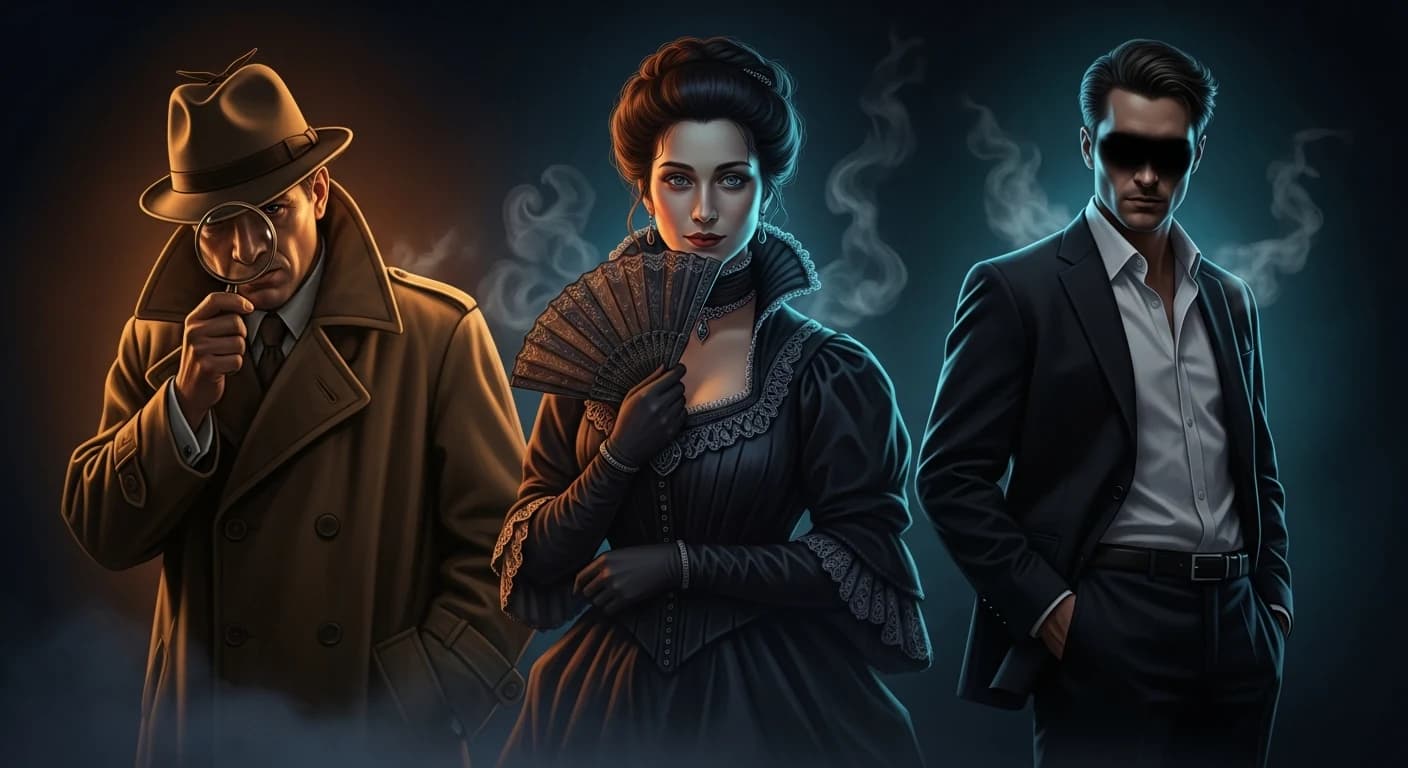
The Mystery Shaper character editor now gives you full control over every character in your custom murder mystery. You can keep the AI-suggested cast as it is, adjust any character — name, gender, personality, habits, catchphrases, even the way they swear — or build a brand-new character entirely from scratch.
This is the deepest customization layer in the wizard, sitting on top of everything you already control: the setting, the time period, the tone, the player count, and your own story idea. (How customization shapes your mystery covers those broader inputs in detail.) Now the people inside that world are yours to shape too.
Why character-level customization matters
A custom murder mystery game is only as memorable as the people sitting around the table — both the real ones playing it and the fictional ones in their dossiers. The plot is the skeleton; the characters are what guests actually remember.
Generic, AI-only characters can feel competent but anonymous. The character editor closes that gap. You can pull your guests, your in-jokes, and the way your friends actually speak straight into the cast — without having to write a script.
You do not have to customize every character. The most common pattern is to adjust two or three characters that fit specific guests, and let the AI handle the rest.
The three modes
When you reach the characters step in the wizard, every character in the suggested cast offers three choices.
1. Keep the suggested character as-is
The fastest path. The AI has already generated a character that fits your story — name, gender, occupation, personality, secrets, motive. If it works, it works. Click Keep and move on.
This is the right choice when you want a fully fictional character — for guests who would rather react to a stranger than play a version of themselves.
2. Adjust an existing character
Take what the AI generated and edit any of it. The most common adjustments:
- Rename the character — sometimes "Margot Featherstone-Hall" is more your group's energy than "Sarah Smith"
- Switch the gender or pronouns — make any character any gender without breaking the plot
- Layer on personality traits — "secretly competitive," "compulsively honest," "treats every conversation as a negotiation"
- Add habits and quirks — fidgets when nervous, laughs at her own jokes, never finishes a sentence, always brings the conversation back to her dog
- Add catchphrases — give the retired professor a verbal tic, give the influencer character her sign-off, write a long-running in-joke into the suspect everyone trusts
- Specify vocabulary or speech patterns — including the occasional swear word if it fits the tone, a specific dialect, or a tendency to mix metaphors
The AI keeps the character's role in the case (their motive, their secret, what they know) intact, while rewriting the dossier, dialogue prompts, and round-by-round reveals to match the personality you described.
3. Build a character from scratch
Replace the suggestion entirely. Describe the character you want — in plain language, as much or as little detail as you have — and the AI integrates them into the plot.
This is the right choice when you have a specific person in mind:
- A barely-disguised parody of the birthday person
- A character who only ever speaks in their best friend's catchphrases
- A friend group recreated as 1920s mobsters, Victorian aristocrats, or Silicon Valley founders
- A long-running in-joke turned into a suspect
The AI handles the integration — slotting the new character into the relationship web, distributing clues and motive, and updating what the other characters know about them.
What you can customize on every character
| Field | What you can change |
|---|---|
| Name | Any name, including titles, nicknames, and honorifics |
| Gender / pronouns | Any gender; pronouns flow through the dossier and dialogue |
| Personality traits | Free-text — write the energy, not just keywords |
| Habits and quirks | Physical, conversational, behavioural |
| Catchphrases | One-liners that appear across the dossier and round prompts |
| Vocabulary / speech | Including dialect, jargon, and yes — swear words if the tone allows |
| Backstory hooks | Relationships, secrets, motives, professional history |
The AI uses every detail you provide. A character with the catchphrase "right, anyway" will use it across her dossier intro, her dialogue prompts, and her reveal moment.
Mix and match across the cast
You do not have to commit to a single mode. The most common setup, in our beta, is something like this:
- Three suggested characters kept as-is — to give the case a fictional core
- Two characters adjusted to fit specific guests — usually the host and the guest of honour
- One character built from scratch — usually a long-running in-joke
The AI weaves all of them into a coherent plot. Motives still line up. Clues still distribute fairly. The mystery still holds together end-to-end.
The wizard re-validates the entire plot after every character change. If a customization would break the case — for example, removing the murderer's motive — the system flags it and offers a fix.
What early users have built
A few of the characters our beta hosts have created:
- "I made the detective a thinly-veiled version of my cousin, who's actually a tax accountant. He didn't realise until forty minutes in."
- "We turned a glamorous heiress into a foul-mouthed roller-derby champion. The AI rewrote her entire arc and somehow it was better than the original."
- "A friend has a habit of ending every argument with 'right, anyway.' Her character does it now too. She knew immediately."
- "I gave the suspect a catchphrase from a film our group has been quoting for ten years. The room lost it the first time he said it."
Frequently asked questions
Does character customization cost extra? No. It is included in every Mystery Shaper custom game.
Can I customize characters in catalog (ready-to-play) games? Customization is part of the custom mystery flow. Catalog games are pre-generated and ship as designed.
How much detail should I write? As much as feels useful. One sentence is enough. A full paragraph is also fine. The AI works with whatever you give it.
Can I add characters who are not in the original suggested cast? Yes — replace one of the suggestions with a brand-new character, or change the player count and the AI scales the cast.
Will the mystery still hold together if I make big changes? Yes. The AI re-validates the plot end-to-end after every change to make sure clues, motives, and round reveals still work.
Can I save a character to reuse in another game? Not yet — we are working on a personal character library so favourite cast members can return.
Try it on your next mystery
Build a custom mystery and try the character editor on your own group. If you are still figuring out what kind of event to host, Murder Mystery Party Ideas for Every Occasion walks through the formats. Once you know the occasion, our complete hosting guide will help you run the night.