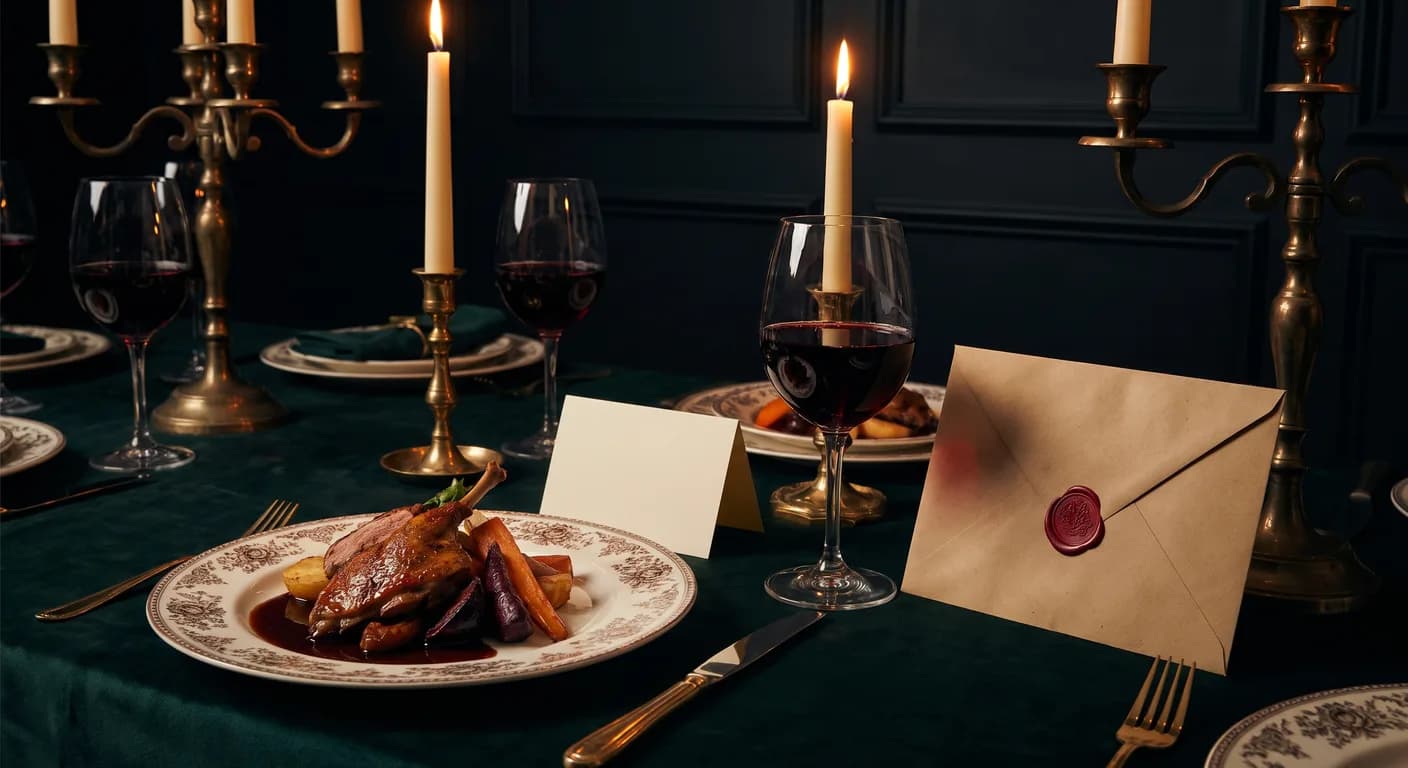
Your mystery is generated, the dossiers are printed, eight people arrive at seven — and then comes the question that quietly wrecks a lot of otherwise good evenings: what are you actually cooking?
Food is not the hard part of a murder mystery dinner party. Timing is. You are not catering from behind your guests; you are sitting at the table with a character, a secret and something to hide. A menu that needs fifteen minutes of your attention in the middle of round two is a menu that takes you out of your own party.
So here is the rule that shapes everything below: nothing gets cooked while a round is running. Every dish either comes out of the oven in a pause, or it was finished this morning.
Our pillar guide, How to Host a Murder Mystery Dinner Party, covers the evening as a whole. This one is only about the food.
The host is a player, not staff
In most murder mystery games the host has two jobs at once. You run the rounds and read the cues, and you also play a character who has to lie to their friends with a straight face. That is already plenty to hold in your head.
Add a menu that needs watching and one of three things happens, every time:
- You miss the game. You are stirring something while the table accuses your character of the murder, and you come back to a scene you cannot follow.
- The game waits for you. Everyone sits there, out of character, listening to a pan.
- The food suffers. You leave it too long because someone finally started talking, and dinner arrives dry.
None of this is a cooking problem. It is a scheduling problem, and it is entirely solvable before anyone rings the doorbell.
Serve between the rounds, never during one
A murder mystery is built in rounds with a pause between each. Three rounds gives you two real breaks, plus the time before round one and the stretch after the reveal. That is four serving slots, and they are the only four you get.
| Moment | What goes out | Why it works |
|---|---|---|
| On arrival, before round 1 | Aperitif and something to eat with fingers | Guests are reading their dossiers and settling into a character. Nobody wants cutlery yet. |
| Break after round 1 | Soup or starter | The table has just met everyone. A plated course keeps them talking in character instead of drifting to their phones. |
| Break after round 2 | Main course | The longest pause of the evening. Whatever needs carving, plating or a hot oven belongs here. |
| After the reveal | Dessert and coffee | The tension is gone and people want to argue about the clue they missed. Dessert should need nothing but a spoon. |
Four courses, four slots. If you want six courses out of a three-round game, two of them share a break and go out back to back — an intermezzo straight after the soup, for example. Extra courses buy you more food, never more time.
The twenty-minute test
Before a dish goes on the menu, ask one question: how many minutes of my hands does it need during the evening? If the answer is more than twenty, it belongs on a different day, or it belongs in the oven before guests arrive. Steaks cooked to order fail this test. A braise that has been sitting in its own sauce since yesterday passes it comfortably.
Three menus that actually work at home
All three are cooked in a normal kitchen with one oven. Quantities scale to whatever your guest count is; the structure is the point.
The quick menu — about 90 minutes of cooking
For a weeknight game, a first-time host, or an evening where your energy belongs to the story.
- Aperitif: sparkling wine with a spoonful of elderflower cordial. Alcohol-free twin: elderflower with sparkling water, plenty of ice and a wide strip of lemon peel.
- Starter: whipped feta with roasted grapes, good olive oil and warm flatbread. Ten minutes in a food processor, then it sits at room temperature until you need it.
- Main: one tray of chicken thighs with lemon, potatoes, olives and oregano. It goes into the oven before the first guest rings and does not mind if round two runs long.
- Dessert: chocolate mousse made the evening before, with flaky salt on top.
Everything except the tray is done in the afternoon. During the game you open the oven once.
The classic menu — about two and a half hours of cooking
The dinner-party standard, arranged so that nothing but reheating happens while guests are in the house.
- Aperitif: gin and tonic with a sprig of rosemary. Alcohol-free twin: tonic with a splash of grapefruit juice and the same sprig.
- Soup: roasted carrot and ginger soup, made the day before, reheated in the break and served in small bowls.
- Main: beef short ribs braised yesterday in red wine, warmed through in their own sauce, with soft polenta and glazed carrots. Braises are a host's best friend: they taste better on day two and a long break cannot ruin them.
- Dessert: pear and almond tart baked in the morning, served just warm with crème fraîche.
The ambitious menu — about three and a half hours of cooking
For the host who enjoys the kitchen as much as the table, and who has the day before free. Six courses across three rounds means two of them share a break.
- Aperitif: dry sherry with salted almonds and olives.
- Starter: salmon cured two days ahead with salt, sugar and dill, sliced onto dark rye with a lemon-dill cream.
- Soup: celeriac velouté with brown butter and toasted hazelnuts, finished the day before.
- Intermezzo: lemon and thyme granita, frozen days in advance and scraped into small glasses. It follows the soup in the same break.
- Main: rack of lamb with potato gratin and green beans. The gratin bakes in the afternoon and reheats; the lamb needs twenty-five minutes in a hot oven, which you start on your way back into round two.
- Dessert: dark chocolate tart with crème fraîche and a little sea salt.
Note what the ambitious menu does not contain: a single dish that has to be finished à la minute. It is more cooking, not more cooking during the game.
Drinks: pour something everyone can have
Someone at your table is driving, pregnant, on antibiotics or simply not drinking tonight, and handing them tap water while everyone else gets a cocktail is a small, avoidable way to leave a guest out.
Give every drink an alcohol-free twin in the same glass: the elderflower spritz next to the sparkling wine, grapefruit tonic next to the gin and tonic, a good cold brew or a proper lemonade next to the wine at the main course. It costs one extra bottle and it makes the evening feel deliberate rather than apologetic.
Dietary needs: change one plate, not the menu
The instinct when a vegetarian guest confirms is to make the whole menu vegetarian. Resist it. You end up cooking something you have never made, for everybody, on the night you also have to run a murder investigation.
The better move is a swap line per dish:
- Vegetarian: the chicken tray becomes halloumi and chickpeas on the same lemon potatoes, out of the same oven.
- Vegan: the whipped feta becomes a white bean purée with the same roasted grapes; the mousse becomes a silken chocolate cream.
- Gluten-free: the flatbread becomes rice crackers, the polenta is already fine, the tart becomes berries with crème fraîche.
- Kids at the table: the braise goes on plain pasta with a spoon of the sauce, and the granita will be their favourite course of the night.
One plate changes. Everyone else eats the menu you planned, and nobody is handed a sad separate meal at a separate time.
The prep timeline that saves the evening
Work backwards from the doorbell, not forwards from the recipe.
- The day before: anything braised, cured, frozen or baked. Soup, short ribs, granita, mousse. This is where the ambitious menu is actually cooked.
- In the morning: the gratin, the tart, the dressing, the gaps on the shopping list. Anything that reheats better than it cooks fresh.
- One hour before guests arrive: the tray into the oven, the table laid, the drinks on ice, the dossiers in a stack by the door.
- During the game: open the oven, plate, carry, sit down again. Nothing else.
If your plan has a step that does not fit one of those four lines, it is not a plan yet.
Let the game plan the menu with you
If you build a custom mystery with us, there is an optional Menu step in the wizard. We propose a dinner menu whose provenance comes from your story's setting, era and occasion — a 1920s club, a Highland estate, a company retreat — but cooked the way a modern home kitchen actually cooks, with ingredients you can buy this week.
You stay in charge of it. You pick the courses you want (aperitif, soup, starter, main, intermezzo, dessert), whether the menu is meat and fish, vegetarian or vegan, how much cooking you are up for — quick at around 1.5 hours, classic at 2.5, ambitious at 3.5 hours hands-on — whether there are kids at the table, and you can add free-text notes about your guests.
The optional Dinner Menu & Serving Guide add-on turns that menu into the document this whole article is describing:
- every dish as a recipe, scaled to your guest count
- a swap line per dietary need, so one plate changes and not the whole menu
- a kids line per course
- a shopping list grouped by aisle
- a prep timeline split into day before, morning, one hour before and during the game
- a serving schedule that maps each course to the break between two specific rounds, because nothing is served during a round
- an alcohol-free twin for every drink
- a spoiler-free menu card for the table as the last page
See it before you decide. We publish a complete sample guide, generated from a real catalog story: download the sample Dinner Menu & Serving Guide (PDF). It is the whole document, not an excerpt — recipes, shopping list, prep timeline, serving schedule and menu card.
A version for games you have already bought is on the way, so a menu is not a decision you have to make at checkout.
Frequently asked questions
What food do you serve at a murder mystery dinner party? Anything you can finish before guests arrive or reheat in a pause. Trays, braises, soups, cured and cold starters, and desserts made the day before all work. Dishes cooked to order do not.
Should you cook during the game? No. The host is a player too, and a round is the one stretch of the evening where nobody can leave the table. Cook before, and use the breaks only to plate and serve.
How many courses fit into a murder mystery dinner? Roughly one per break, plus something on arrival and dessert after the reveal. A three-round game comfortably carries four courses; six courses means two of them share a break and go out one after the other.
What if a guest is vegetarian, vegan or has an allergy? Change that one plate, not the menu. Swap the protein or the base of a single dish so that guest eats the same meal in the same rhythm as everyone else.
Can you order in instead of cooking? Yes, and it follows the same rule: have the delivery arrive during a break, not during a round, and pick food that survives twenty minutes in a warm oven.
Do you have to serve dinner at all? No. A murder mystery works with snacks and drinks alone. The food is there to create natural pauses and make the evening feel like a dinner party rather than a board game.
Cook once, then play your own game
The best murder mystery dinner is the one where the host is at the table for every round. That is a menu decision, and you make it days before anyone arrives: cook ahead, serve in the pauses, give every course a slot and give yourself none.
Build your custom mystery and add the menu step while you are shaping the story — the food and the rounds then come out of the same plan, which is the entire point.
You might also enjoy
- How to Host a Murder Mystery Dinner Party — the whole evening, from invitations to the reveal.
- What to Do When a Guest Cancels — when the headcount moves after you have already bought the groceries.
- Murder Mystery Party Ideas for Every Occasion — pick the setting first; the menu follows from it.