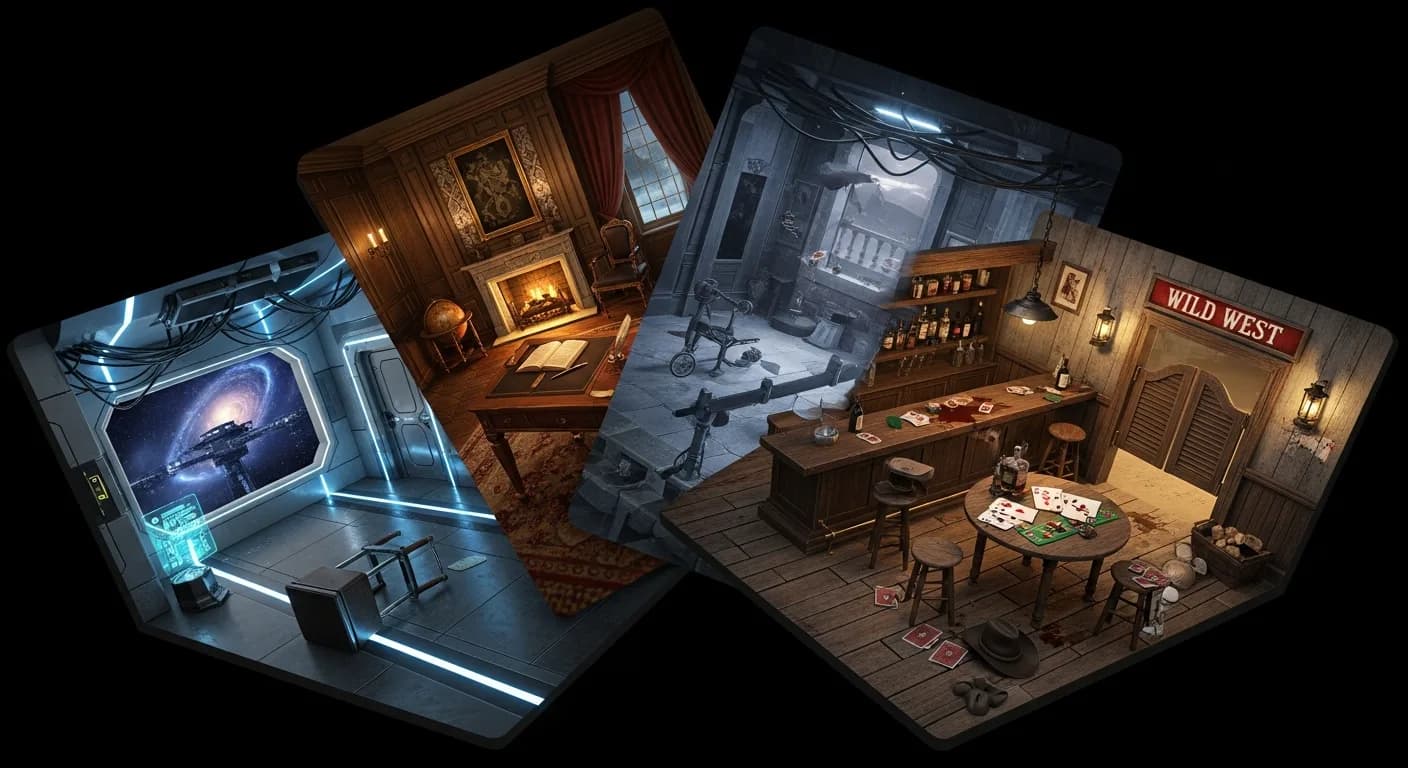
You choose the setting, the time period, the tone, and the player count — and you get a game built around exactly those choices. No pre-written box, no fixed story. Everything is generated from your inputs: the characters, the motives, the evidence, the entire plot.
How much of a difference does that actually make? This article shows you — using real games from our catalog.
What your inputs actually change
Depending on the setting, time period, and tone you choose, you get:
- Different characters — not just different names, but people who belong in the world you picked
- Different motives — shaped by the social dynamics of your chosen setting
- Different clues and evidence — fitting the era and the location
- Different relationship webs — tighter with fewer players, more complex with more
- A different feel at the table — from tense thriller to chaotic comedy
1. Add your own story idea, and the plot itself changes
MysteryShaper gives you an optional field called Your Own Story Idea during story selection. This is the clearest point where customization stops being about atmosphere and starts changing the actual case.
You can tell the system things like:
- The murder should involve poisoning
- The host has been secretly embezzling funds from the charity they all support
- The victim was killed with a ceremonial dagger from the host's private collection
Those are not flavour notes. They change the motive structure, the clue trail, and the final reveal. A poisoning mystery needs different opportunities, suspects, and evidence than a staged accident or a theft gone wrong.
That means the game is not just choosing a skin. Your brief changes what kind of mystery it is allowed to become.
2. Change the setting, and you change the whole social world
A custom murder mystery set in a tech company needs different suspects and different evidence than one set in a manor house or a space station.
The Great Gadget Getaway is a Silicon Valley startup mystery. Its cast makes immediate sense for that world: a head of marketing, an office manager, a junior coder, and a barista who hears everything. The clues fit too: patent filings, vault access, office politics, and old building infrastructure turned into evidence.
The Ravenscroft Christmas Mystery moves the same dinner-party format into a Victorian manor. Now the pressure points are inheritance, reputation, servants' knowledge, hidden passages, and handwritten correspondence.
A Cosmic Comedy of Errors pushes the format into a failing space station. The logic of the evidence changes again: airlock records, system logs, mission hierarchy, and the kind of tension that only exists when nobody can leave.
That is what real setting-level customization looks like. The setting is not decoration. It decides which secrets, motives, and clue types belong in the story at all.
3. Change the time period, and the evidence changes with it
Time period is more than costume. It changes what power looks like, what people fear, and what counts as believable evidence.
The Ravenscroft Christmas Mystery, set in 1894, runs on social standing, household hierarchy, letters, ledgers, and the threat of scandal.
Blood and Betrayal at Castle Blackthorn, set in medieval Scotland, runs on clan loyalty, oaths, seals, daggers, and religious authority.
Both are classic enclosed-circle mysteries with six suspects. But the world rules are different, so the investigation feels different. A Victorian clue trail does not work the same way as a medieval one, because the surrounding society is not the same.
4. Change the tone, and you change the guest experience
Tone is one of the most underrated customization inputs because it changes not just the writing, but the way people play.
The Boardroom Backstab is a classic corporate mystery. The atmosphere is sharp, ambitious, and suspicious. The clues ask players to read status, betrayal, and professional leverage seriously.
The Great Gadget Getaway also lives in a modern workplace, but it pushes the same broad space toward comedy. Now the world includes theatrical egos, old pneumatic tubes, ridiculous cover stories, and clue logic that still works while inviting laughter along the way.
The underlying format is still a murder mystery game. But one version drives tension, and the other drives chaos and fun. That difference is not cosmetic; it changes what kind of night your guests are having.
5. Change the player count, and you change the shape of the case
Player count is not just a packaging detail. It changes how dense the web of relationships can be.
4 players: In The Great Gadget Getaway, every suspect matters immediately. There is nowhere to hide. Every clue lands directly on one of the people at the table.
6 players: In The Ravenscroft Christmas Mystery, there is more room for split loyalties, shared secrets, and red herrings. The case breathes more.
8 players: In The Director's Cut, the mystery becomes an ensemble piece. You get side plots, more alliances, more misdirection, and more moments where one player's secret matters even when it is not the main murder solution.
More players does not just mean more names. It means a structurally different mystery.
Real customization is structural, not cosmetic
A genuinely custom murder mystery should change more than names. It should change the suspects, the motives, the clue types, the tone, the pacing, and the logic of the case.
That is the real point of the examples above. The value is not just variety for its own sake. Your story idea can change the case itself, while setting, time period, tone, and player count change the world around it.
For a quick overview of every input you can shape, see our custom mystery page. Build a custom mystery if you want to see what your own inputs create. If you are still deciding what kind of event to host, start with Murder Mystery Party Ideas for Every Occasion. Once you know the occasion, our complete hosting guide will help you run it. If you are still comparing ready-made and custom formats, read How to Choose the Right Murder Mystery Game.