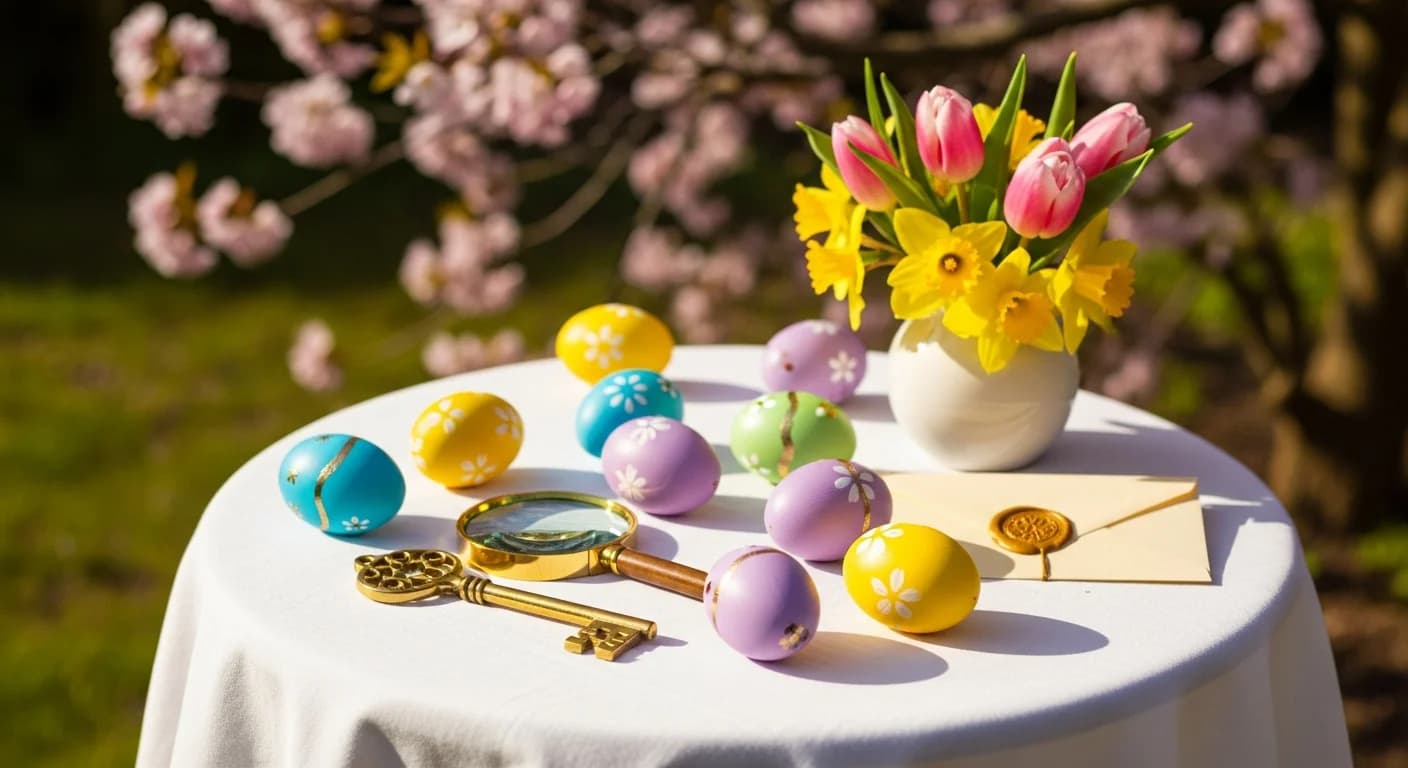
Easter gatherings have a reputation problem. The food is great. The company is lovely. But once the eggs are found and the chocolate is eaten, the afternoon tends to drift into that familiar territory of small talk and second helpings.
What if the eggs weren't just hidden — they were evidence? What if each one contained a clue, and someone at your Easter table had a secret worth killing for?
A murder mystery Easter egg hunt takes two things people already love — hunting for hidden things and accusing each other of suspicious behaviour — and turns them into one genuinely memorable afternoon.
Here's how to pull it off.
What is a murder mystery Easter egg hunt?
The idea is simple. Instead of a traditional egg hunt where the goal is just to collect as many eggs as possible, each egg contains a clue that's part of a larger murder mystery.
Guests arrive, get assigned their characters, and the mystery begins. At key moments throughout the game, everyone heads out for a "round" of the egg hunt. The eggs they find contain evidence — alibis, secret motives, witness statements, forensic details — that feed directly into the mystery they're trying to solve.
The hunt isn't just a side activity. It's the investigation. Every egg matters, and every clue changes what the group thinks they know.
This format works for groups of all sizes — from intimate gatherings of 4–6 people to large family events with 10 or more. The mystery gives the afternoon genuine structure, real stakes, and a satisfying conclusion that everyone remembers.
How to set up a murder mystery egg hunt
You'll need two things: a murder mystery game and some Easter eggs to put the clues in.
Step 1: Get your murder mystery game
For the mystery itself, you can use MysteryShaper to generate a custom game that fits your group perfectly. Enter your number of players, pick an Easter-appropriate setting — a country estate, a spring garden party, a village fête — and choose from the story options it generates. The game comes with all the clues, character packs, host guide, and the full storyline.
Alternatively, browse the catalog for a ready-to-play mystery you can download instantly and adapt for an Easter setting.
Step 2: Prepare the eggs
Once you have your mystery, take the clues from each round and print them small enough to fold into plastic Easter eggs. Colour-code the eggs by round — pastel pink for Round 1 clues, blue for Round 2, yellow for Round 3 — so you can hide them in batches and reveal them at the right time.
A few practical tips:
- Use numbered clues. Each clue in a MysteryShaper game has a number and is assigned to a specific character. Print the clue number on the outside of the egg so players know which one to open.
- Waterproof your clues. If you're hiding eggs outside, slip each printed clue into a small ziplock bag before putting it in the egg.
- Hide in rounds, not all at once. Only hide the current round's eggs before each hunt begins. This prevents players from finding clues out of order.
Step 3: Run the game
Hide each round's eggs before guests go hunting. Between rounds, everyone comes back to the table to discuss what they found, accuse each other, and lie through their teeth. The host guide tells you exactly when to release each set of clues and how to facilitate the discussion.
How to make it work for different group sizes
Families with kids and adults
Run two parallel hunts. The kids get a traditional egg hunt with chocolate and treats. The adults get the mystery eggs. Everyone hunts at the same time, but only the grown-ups are solving a murder. The kids think they're winning because they found more eggs. The adults think they're winning because Uncle Stefan just got caught in a lie about his alibi.
This is hands-down the best way to keep both groups entertained simultaneously. The kids are occupied, the adults are engaged, and nobody is bored.
All-adult Easter gatherings
Lean fully into it. Assign characters in advance so guests arrive in costume. Hide the eggs across your entire garden or apartment. Make the stakes feel real — the person who correctly solves the mystery gets a prize (a good bottle of wine, the last slice of cake, permanent bragging rights).
For added drama, serve lunch between rounds. Eating in character while interrogating the person across the table is peak murder mystery entertainment.
Small groups of 4 to 6 people
A murder mystery works brilliantly with a tight group. Fewer players means more clues per person, more intense interrogation, and nowhere to hide. The egg hunt becomes a focused investigation rather than a chaotic free-for-all.
Small groups also allow for deeper character interactions. Every conversation matters, every accusation lands harder, and the reveal at the end is more satisfying because everyone was genuinely invested. For a real example of how a small-group mystery plays out, read about our 4-person birthday mystery experience.
Easter murder mystery theme ideas
The best Easter murder mysteries lean into the season without being too on-the-nose. A few settings that work beautifully:
- A spring garden party gone wrong. An elegant outdoor gathering where someone doesn't make it to dessert. Very Agatha Christie, very Easter.
- A country estate weekend. Guests arrive for a long Easter weekend, and by Saturday evening, there's a body in the conservatory.
- A village Easter fair. A charming, small-town event with a dark secret underneath. Think Midsomer Murders meets Easter bonnet competition.
- A chocolate factory tour. Someone sabotaged the production line — and it wasn't an accident. Whimsical, fun, perfect for groups who prefer comedy over drama.
- A historic manor house mystery. An old family gathers for their annual Easter reunion, and long-buried secrets come to light.
With MysteryShaper, you can enter any of these as your setting and the AI will build the story around it. You're not limited to whatever's available in a box — you describe the Easter gathering you want, and the mystery is generated to match.
Sample timeline for a 3-hour Easter mystery afternoon
Here's a schedule that works well for a typical Easter mystery event:
1:00 PM — Arrival and character reveal. Guests arrive, receive their character packs, and get into character over drinks and snacks. Give everyone 15 minutes to read their pack and start asking suspicious questions.
1:30 PM — Round 1 egg hunt. Everyone heads outside (or around the house) to find the first batch of eggs. Each egg contains a Round 1 clue. Back at the table, discuss findings and make initial accusations.
2:15 PM — Easter lunch/dinner. Serve the meal. In character. This is where the real drama happens — alliances form, secrets slip out, and someone inevitably overcommits to their alibi while reaching for the potatoes.
3:00 PM — Round 2 egg hunt. New batch of eggs, new evidence. The plot thickens. Back to the table for more intense interrogation.
3:30 PM — Final round and the big reveal. Last eggs, final clues. Everyone makes their accusation. The solution is read aloud. Someone is vindicated. Someone is exposed. Everyone argues about whether the clues were fair.
4:00 PM — Dessert and post-game chaos. Chocolate eggs, cake, and the kind of heated post-mortem analysis that makes the whole thing worth it.
You can adjust this timeline based on your group. Shorter games work with two rounds instead of three. Longer gatherings can add more rounds or extend the meals between hunts.
Why a murder mystery egg hunt works so well
The reason a murder mystery egg hunt works so well is that it solves the two biggest problems with Easter gatherings: the egg hunt ends too quickly, and the afternoon needs more structure.
By spreading the hunt across multiple rounds and tying it to an actual mystery, the egg hunt becomes the backbone of the entire afternoon rather than a ten-minute activity. And the mystery gives everyone something to focus on, talk about, and argue over — which is exactly what a good gathering needs.
It works for families. It works for friends. It works for groups of four and groups of twelve. And because the mystery is generated around your inputs — your group size, your setting, your preferred tone — it fits your Easter gathering specifically, not some generic template.
The combination of physical activity (the hunt), social deduction (the mystery), and communal dining (the Easter meal) creates a varied, engaging afternoon that keeps people entertained for hours without ever feeling forced.
Start planning your Easter murder mystery
Head to mysteryshaper.com, enter your group details, pick an Easter-inspired setting, and choose the story you want. Print the clues, fold them into eggs, and hide them before your guests arrive.
If you'd rather start with a ready-made game, browse the catalog for instant download options.
This Easter, give your guests something to actually investigate.
You might also enjoy
- Murder Mystery Party Ideas for Every Occasion — More ideas for birthdays, holidays, game nights, and special events.
- How to Host a Murder Mystery Dinner Party — The complete guide to running a murder mystery evening from start to finish.
- Boxed Murder Mystery Kits vs AI-Generated Games — Which format is best for your group?