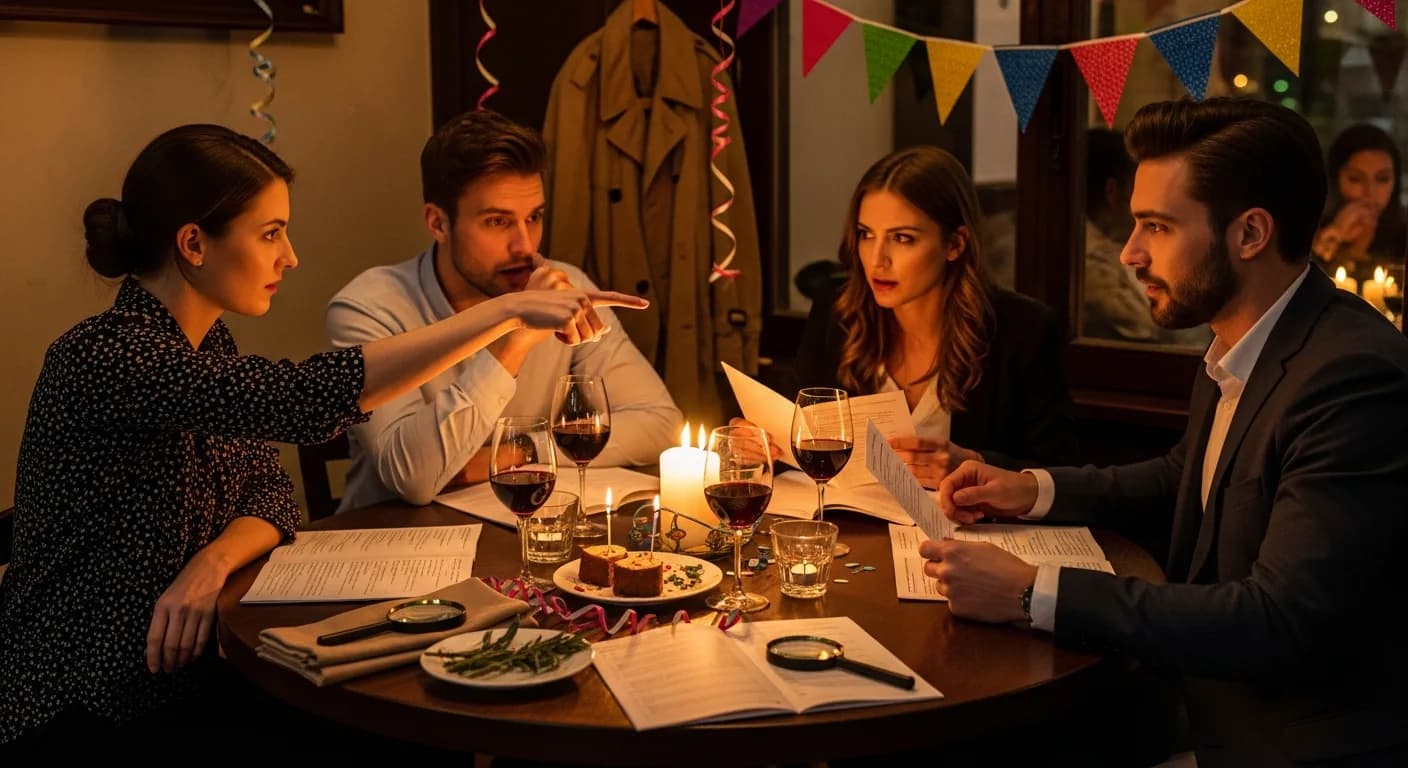
Let me set the scene.
It's my friend Sarah's 35th birthday. She's the kind of person who has genuinely seen everything — every restaurant, every escape room, every bottomless brunch. She's been to a wine tasting that ended in a heated debate about regional French appellations. She once described a perfectly good surprise party as "predictable." Planning her birthday every year is, frankly, a challenge.
This year, I decided to try something I'd never done before. A murder mystery night, generated by AI, built entirely around our group. And I want to tell you exactly how it went — the good, the absolutely chaotic, and the moment Marcus accused the birthday girl of her own murder within the first twenty minutes.
How we set up an AI murder mystery for 4 people
There were four of us. A tight group — Sarah, me, Marcus (who has never once in his life done anything quietly), and Emma, who is so calm and measured that the rest of us have always suspected she's secretly running some kind of long game.
I went to MysteryShaper and entered everything: four players, an evening birthday celebration, a 1920s speakeasy setting (Sarah's favourite era — she'd kill me if I picked anything else), and a game length of about three hours. The platform generated several different story options for me to choose from.
This is the part I didn't expect to love as much as I did. I actually got to choose the story. Not "here's your mystery, good luck" — actual options, each with a different premise, different characters, different tone. I read through them like I was choosing a film for the night. One was a dark noir thriller. One was a chaotic comedy involving a stolen jazz record and a crooked senator. I picked the comedy one immediately.
Downloaded. Done. Four character packs, a full storyline, clues, and a solution — all ready to go.
I did not tell anyone what they were walking into.
What you actually get in a MysteryShaper game
Before I get into what happened on the night, let me explain what arrived in the download — because the quality of the materials matters a lot for how the evening feels.
Each of the four players got their own character booklet. Not a single sheet with a name and a paragraph — a proper booklet with:
- Their full backstory and public persona
- A dangerous secret they needed to protect
- Specific goals and agendas for each round
- Scripted dialogue for key moments
- A list of relationships with every other character
I also got a comprehensive host guide with the full solution, the game flow, and tips for running each round. And there was audio narration — a narrator voice that sets the scene at the start and guides the transitions between rounds. It felt like opening a boxed game, except everything had been built specifically for our group.
The whole package took about five minutes to generate after I chose the story. I printed the character booklets, sealed them in envelopes, and waited for Saturday.
How the evening actually played out
The first twenty minutes
Everyone arrived, got their envelopes, and went quiet for exactly eight minutes while they read their characters. Then Marcus looked up and, completely unprompted, accused Sarah of being the murderer. In the first round. Before anyone had presented a single clue.
His reasoning? "She's been too calm. She hasn't even asked a question yet. That's exactly what a guilty person would do."
Sarah was, in fact, not the murderer. But she spent the next hour defending herself so aggressively that everyone became more suspicious of her, which is exactly the kind of dynamic that makes these evenings brilliant.
The middle rounds
By the second round, alliances had formed. Emma and I were quietly comparing notes in the kitchen while pretending to refill drinks. Marcus had appointed himself lead investigator and was interrogating everyone with the intensity of someone who had watched far too many crime documentaries.
The clues were genuinely well constructed. Each round revealed new information that reframed what we thought we knew. A clue that seemed to point at one character in Round 1 took on a completely different meaning by Round 3. The story had real layers, and the deduction was fair — you could actually solve it if you paid attention.
The reveal
The final round was intense. Everyone had a theory. Everyone was wrong — except Emma, who had been silently correct since Round 2 but never said a word because she "wanted to see how it played out."
The narrator audio played the conclusion, the solution was revealed, and Marcus was the murderer. He had been deflecting suspicion onto Sarah the entire time, which, in retrospect, was brilliant. We talked about it for the rest of the evening.
What did the AI-generated murder mystery actually get right?
Here's the thing I want to be honest about: I was a little skeptical going in. An AI-generated story for a specific group of specific people — would it actually feel personal? Would it be generic in the way these things sometimes are?
It wasn't.
Because I'd entered our exact inputs — four players, the setting I wanted, the game length that worked for the evening — everything fit. The story had the right tone for our group (chaotic comedy, not po-faced thriller). And because I got to choose from multiple generated story options rather than being handed one, I picked the story I knew would work for Sarah's birthday specifically.
Nobody felt left out. Nobody was stuck with a character that made no sense. The story held together right up to the reveal — and the reveal was genuinely surprising, which is harder than it sounds.
The character booklets were detailed enough that everyone had something to do in every round. No one sat around waiting for their moment. And the audio narration added atmosphere without requiring me to read aloud from a script like some kind of amateur theatre director.
What I would do differently next time
A few things I'd change for next time:
- Print the booklets earlier. I printed them the morning of, which felt rushed. Give yourself a day.
- Prepare themed snacks. We had regular food, which was fine, but themed food between rounds would have been more immersive.
- Tell guests to come in costume. I didn't want to give anything away, but even vague costume guidance ("dress for the 1920s") would have added to the atmosphere.
- Don't tell anyone the format. This was actually the right call. The surprise of discovering it was a murder mystery night made the first ten minutes electric.
We are doing it again for New Year's.
Would I recommend an AI murder mystery for a birthday party?
If you're planning a birthday for someone who's hard to surprise — yes, immediately.
If you have a group where at least one person takes things a little too seriously and another will commit to absolutely anything — yes, this is the format for you.
If you want an evening where you're genuinely not sure what's going to happen, where people reveal sides of themselves you didn't know existed, and where someone (inevitably) delivers an unprompted four-minute alibi monologue — yes.
The whole experience — from entering the inputs to choosing the story to downloading everything — took me around 5–10 minutes. The night itself gave us stories we'll be telling for years.
Sarah still brings up the sequin comment. Marcus maintains it was a valid observation.
If you want to try it yourself, start at mysteryshaper.com. Enter your group size, pick your setting, choose the story that fits — and let your guests do the rest. Or browse the catalog if you'd rather pick a ready-made game and download it immediately.
You might also enjoy
- Murder Mystery Party Ideas for Every Occasion — Birthday, game night, holiday, bachelorette: find the perfect theme for your event.
- How to Host a Murder Mystery Dinner Party — The complete step-by-step hosting guide.
- How to Choose the Right Murder Mystery Game — Boxed kits, digital games, and AI-generated mysteries compared.