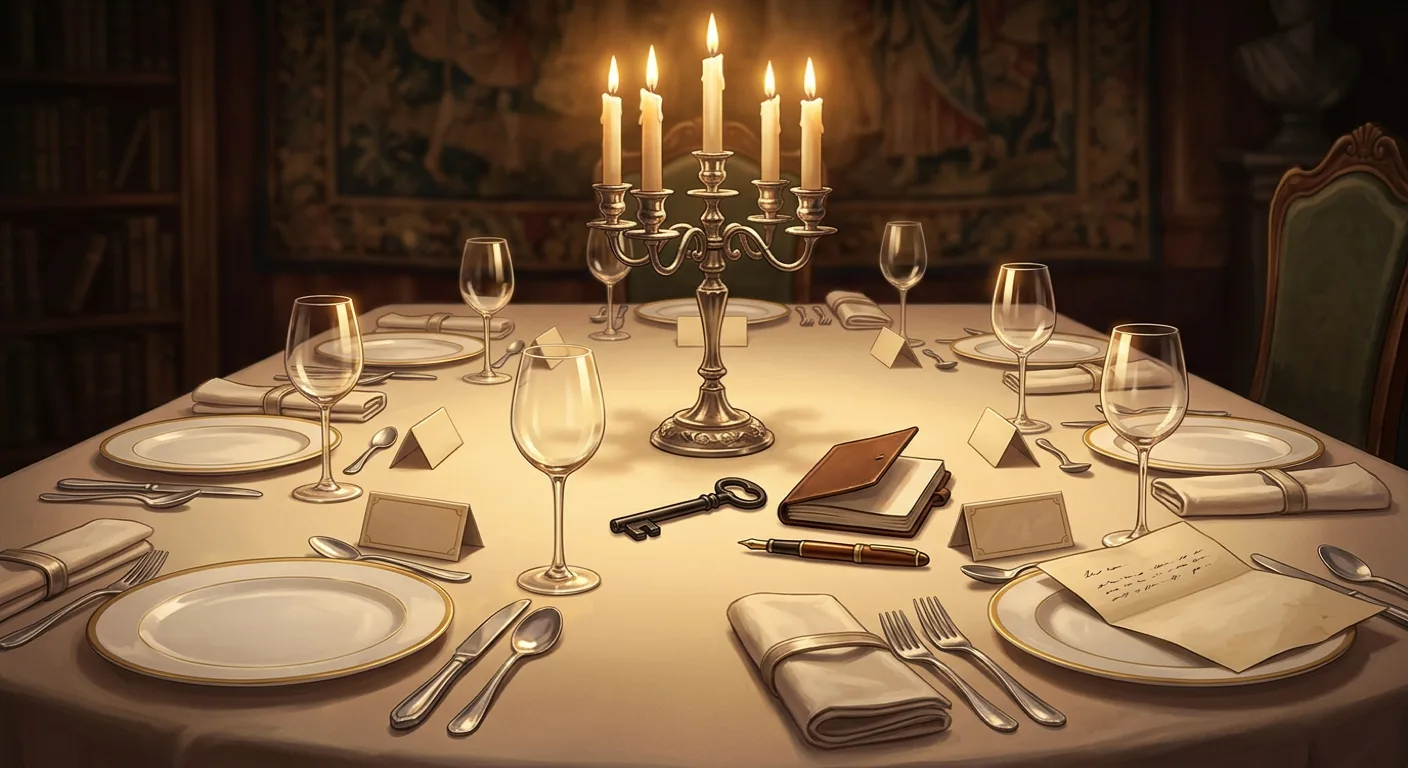
Six players is the sweet spot for a murder mystery dinner party — and if you're not sure what size to aim for, this is the number to choose. It's big enough for a genuinely twisty web of suspects and secrets, yet small enough that everyone stays in the action and the case stays easy to follow. It's the most popular size we see, and the one we'd recommend to any first-time host.
This guide explains exactly why six works so well, what the evening looks like, and how to get a mystery built for six that holds together from the first clue to the final reveal.
Why 6 players is the ideal number
A murder mystery lives or dies on its web of motives — who had a reason, who's lying, who benefits. Six players hits the structural sweet spot for that web:
- Rich enough to be hard. Six suspects, six tangled motives, six sets of secrets. That's plenty of misdirection for a case that genuinely keeps people guessing until the end.
- Small enough to follow. You can hold six characters and their relationships in your head. Players actually reason their way to the killer instead of losing track of who's who.
- Everyone stays busy. Six is enough for proper alliances and side-conversations, but no one ends up sidelined. Every player has people to interrogate and secrets to protect every round.
- It's the most forgiving to host. Big enough to feel like an event, small enough to run solo. If it's your first time, six is the size that makes you look like a pro.
If four players is intense and intimate, and eight is a buzzing party, six is the balance point that gets the best of both.
What a 6-player evening looks like
Picture a dinner table of six. As the rounds unfold, the room splits into quiet conversations — two guests comparing alibis by the window, another pair trading accusations over dessert. There's enough going on to feel like a real social event, but you can always see the whole table and follow every thread.
A 6-player game typically runs 2 to 2.5 hours, which fits a dinner party perfectly: a round before each course, the reveal over dessert. It's long enough to feel like a proper evening, short enough that it never drags.
Because six is such a natural dinner-party size, the practical logistics are easy too:
- Seating is simple — six fits any normal dining table.
- The host can play. At six, you comfortably play a character and run the game at once; no dedicated facilitator needed.
- The menu can be as ambitious or as easy as you like — six is a very manageable number to feed.
Who 6 players is perfect for
- First-time hosts. The most forgiving size to learn on. Enough drama to be exciting, few enough people to keep control.
- A classic dinner party. Six around a table is the timeless dinner-party number — a murder just makes it unforgettable.
- A mixed group. Six gives room for the serious sleuths and the friends who are mostly there for the theatrics, without either spoiling the other's fun.
- Small celebrations. A birthday dinner, an anniversary, a reunion of close friends — six is the right scale for an evening that feels special but intimate.
For more ways to theme a six-person evening, our party ideas for every occasion covers birthdays, holidays, and more.
Getting a mystery that's actually built for six
The catch with boxed kits is fixed player counts. If a box is printed for eight and six show up, two suspects vanish and the motive web develops holes; print it for four and you're padding it out. Either way the case stops being airtight.
A custom mystery is generated for your exact number. When you build a game for 6 players, you get six balanced suspects, motives and clues distributed evenly across all of them, and a case validated end-to-end so it solves cleanly with six at the table. The relationship web is designed for six — not stretched or trimmed to fit.
Prefer to start tonight? Six is the most common size in the catalog, so you'll find plenty of ready-to-play stories written for exactly six players. (Curious how the count and setting reshape the game? See what changes when you customise.)
Frequently asked questions
Is 6 the best number of players for a murder mystery?
For most groups, yes. Six is the sweet spot: enough suspects for a rich, twisty mystery, but few enough that everyone stays involved and the case is easy to follow. It's the most popular size and the one we recommend to first-time hosts.
How long does a 6-player murder mystery take?
Typically 2 to 2.5 hours — a round before each course and the reveal over dessert. That makes six an ideal fit for a dinner party that feels like a full evening without running late.
Does the host play in a 6-player game?
Yes. At six players, the host comfortably plays a character and runs the game at the same time. You don't need a dedicated, non-playing facilitator until groups get larger.
Can you play a murder mystery with 6 people including the host?
Yes — six total, host included, is a perfect setup. The host takes one of the six characters and guides the game between courses.
What if one guest drops out and I'm down to 5?
With a custom mystery you can regenerate the game for five so the case still balances. With a fixed catalog game, the host can sometimes absorb a missing role, but a game built for your actual count always plays cleaner.
Set up your 6-player mystery
Six is the safe, satisfying choice — and the easiest night to host. Build a custom mystery for 6 players and get a perfectly balanced case, or browse the catalog for a ready-to-play six-player story you can start tonight.
Wondering whether a different size suits your group better? Our guide to how many players you need compares every option.
You might also enjoy
- How Many Players Do You Need for a Murder Mystery? — The complete breakdown by group size.
- Murder Mystery for 4 Players — A smaller, more intense whodunit.
- Murder Mystery for 8 Players — Scale up to subplots and party energy.